_JPG.jpg)
What is plasma?
- SciSteins

- Apr 26, 2020
- 2 min read
A wooden ship is sailing back home under a heavy thunderstorm. As the weather settles down, a peculiar phenomenon starts happening on the tip of the mat. The tip begins to glow intensely, producing a hue that contrasts with the dark starry night. What could this be?

Saint Elmo's fire, by PeterPawn on DeviantArt
This phenomenon has been observed a few times through history, mostly by sailors. Most tried to give it a meaning, such as a mythical manifestation of a saint or a god, depending on the cultures. Generally seen as a good omen, this phenomenon was coined after the patron saint of sailors (Erasmus Formia). It's name? St. Elmo's fire!
Scientists have another name for it, they call it plasma. St-Elmo's fire is one manifestation of plasma among others. Plasma in the case of St. Elmo's fire, is usually created under stormy weather, when there is enough electric potential difference or voltage between the surface of the sea, and the sky. This voltage charges the particles around the tip of the mat, which in turn interacts with the surrounding air to produce plasma. Plasma in this case, is produced as the electrically charged tip, rips off electrons from the gas atoms, producing ions and free electrons - this is referred to as ionization.
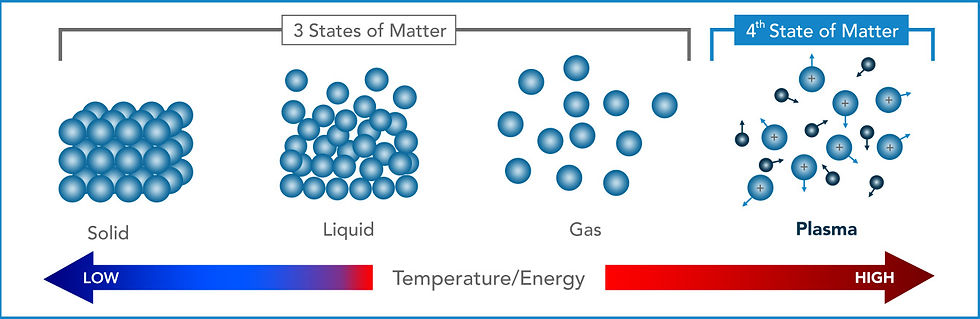
Plasma is also the 4th state of matter. Since it's electrically charged, it conducts electricity and reacts to magnets, which makes it different than a gas in terms of proprieties. The temperature of a plasma can also climb up very high, to thousands and even millions of Kelvins, so in order to express its temperature in a practical way, we use electron-volts. 1 eV = 1.16*10^4 Kelvins.
Maxwell-Boltzmann distribution
Since plasma can be described as a system with moving particles, we can describe their speed per amount of particles as a Maxwell-Boltzmann distribution. If we heat up the system, the kinetic energy of the particles (their speed) increases, which means the curve becomes more elongated but also flatter since the number of particles remains the same.

To fit the criteria of a plasma, the total negative charges (electrons), must be equal to the total positive charges (cations, which are positively charged ions), on a macroscopic scale. Meaning that the whole plasma is neutral. This is referred to as quasineutrality. The electromagnetic forces must also dominate over normal hydrodynamic forces in the system.
Plasma is everywhere
Plasma is ubiquitous. Some manifestations of it include stars, giant balls of plasma where fusion generates enough heat to ionize the particles and lightning. Plasma is also found between stars and galaxies in the interstellar medium but you'll probably be able to see the manifestations of plasma in your life not far from home. Take a closer look at your fluorescent lamps, which produce light by the same principle - ionization.

When you turn the lights on, the electric current ionizes the gas in the bulb (usually its argon, a noble gas), which becomes plasma by losing its electrons. This plasma then interacts with the phosphor coating of the lamp to produce light!
- Lifeyard
Sources
USYD - Senior Plasma Physics Lecture

Comments