_JPG.jpg)
Arrow of Time
- SciSteins

- Apr 29, 2020
- 3 min read
Updated: May 3, 2020
Why does time have a direction? What is consciousness? Is there a single possible past? Is the present moment physically distinct from the past and future, or is it merely an emergent property of consciousness? And, the most important question of them all; why do we exist?
The Universe we cognize is based on the space-time hypothesis, in which events take place. Events are characterized by their locations in space and moments in time, indicated in terms of coordinates. The number of coordinates necessary for an event is known as its dimension of space-time.

Imagine that you're in your spacesuit in the space far away from the influence of the Earth, or any massive gravitating body. All directions of space would look equal to you. The laws of physics don't know any difference between various orientations in space. But in contrast. time has two directions, forward and backward, the past and the future. You might walk around an unknown place and take a wrong turn, but no one can take a wrong turning to the past. You remember the past, but you do not recall, most of us, what happens in the future. You can influence the future, but you cannot alter the past. The Backwards Causality is rejected, the past should not depend on the future. This difference between the past and the future can be explained in terms of the arrow of time. Unlike space, the time has a direction pointing from the past to the future.

Newtonian Mechanical models generally treat the past and the future completely identically. There is no arrow of time when we take the fundamental laws of physics into consideration. The laws of physics that describe the collision of two particles, let’s consider an event where two balls in the game of billiards bump into each other and go their own way, are completely reversible. Any trajectory, any solutions to these equations work equally well when played backward in time.
But the circumstances of the events change when there are lots of particles in the system, resembling the accumulation of quantum states of matter. In an event of billiards game, when someone smacks the cue-ball to randomly scatter the racked object balls in their starting positions, the event cannot be undone. You’ll never see them arranged into a nicely racked orderly configuration in a closed system i.e., without any outside interference. The arrow of time comes into existence when we shift from a couple of particles to a large number of particles.

As time passes the world gets messier --more chaotic. Disorder in the universe increases with time. An isolated system only ever has an increase in entropy (Statistically Disordered). That is the second law of Thermodynamics. The fact that we are first born, then live and then we die, is also because of the increase of entropy with time. The fact that biological evolution starts from just a few unicellular organisms to all of the complexity we have today, is also because of entropy. The fact that we remember the past but not the future is also because of entropy. Ludwig Boltzmann said that entropy counts the indistinguishable arrangements of a system. Suppose we break an egg and make an omelet of it, we cannot change the omelet back into its initial state, the egg. That's because the entropy has increased during the process, and hence the event cannot be reversed. But a quantum mechanical experiment on an IBM quantum computer shows that it’s entirely possible that the arrow of time can be reversed, too.
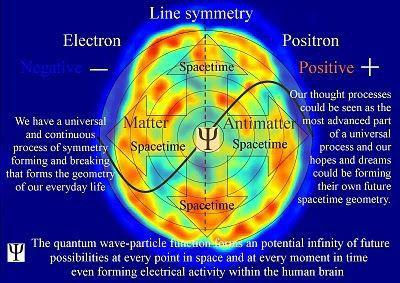
If we study profoundly into quantum mechanics, we discover that there are two basic levels of realities that we live in. So far we have observed the arrow of time, based on the reality abided by the laws of physics, laws of thermodynamics, etc. The other level of reality is that the human state of awareness can actually shift energy. The arrow of time has a deep psychological justification. Cognitive science helps us understand it, not as a parameter of complex mathematical and scientific models, but as a concept of the mind, allowing us to formalize the world in such a way to distinguish the past from the future. These phenomenons are yet to be completely interpreted by scientists as they don’t have any abstract laws to validate the theories. But what we can assure is that time is a very essential concept which exists in every realm of science and forms the base quantity for many equations which helps us better understand the universe.
Now I encourage the reader to comment below about their thoughts regarding the questions that were asked at the beginning of the blog. Don't forget to share this blog with your friends and relatives.
- LoopGlitch
Sources
A lecture by Sean M. Carrol on the Origin of the universe and arrow of time

Comments