_JPG.jpg)
Entomology I - Insect Head
- SciSteins

- May 3, 2020
- 4 min read
Insects crawl, jump and fly all around us, yet they are poorly understood, even misunderstood. This series goal is to shed some light on a field of study called Entomology – The study of insects. But first of all, do you know what an insect is? Would you be able to define it? Could you spot the insect among the species on the picture below?

The answer lies at the end of my post.
An insect is a small invertebrate, an arthropod more specifically – like all arthropods, they have a bilateral symmetry which means they can be sliced from head to abdomen, making 2 mirror images. Furthermore, they have an exoskeleton, segmentation, articulated appendages, an open circulatory system (meaning that their “blood” called hemolymph bathes and slouches around the organs in a cavity called hemocoel. Also, they can molt.
What makes insects different from other arthropods? Well, they have 3 body parts (head, thorax, abdomen, adults have 6 legs, they have paired openings on their sides – spiracles for breathing and a system of pipes - trachea, for gas exchange.

If you look closely, you can see the spiracles on the sides of the abdomen. PS: not all insects have wings, this is not a requirement to be an insect.
A GENERAL INTRODUCTION TO THE INSECT HEAD The insect head varies a lot, but we can find some common denominators. The labium and maxillae form the palps and can be used as taste receptors and are also used to manipulate the food. Besides the palps, insects have taste receptors on their footpads and on the outside and inside of their mouth. That way, they know if a source of food is noxious. Several species have thousands of receptors in multiple locations in the body.
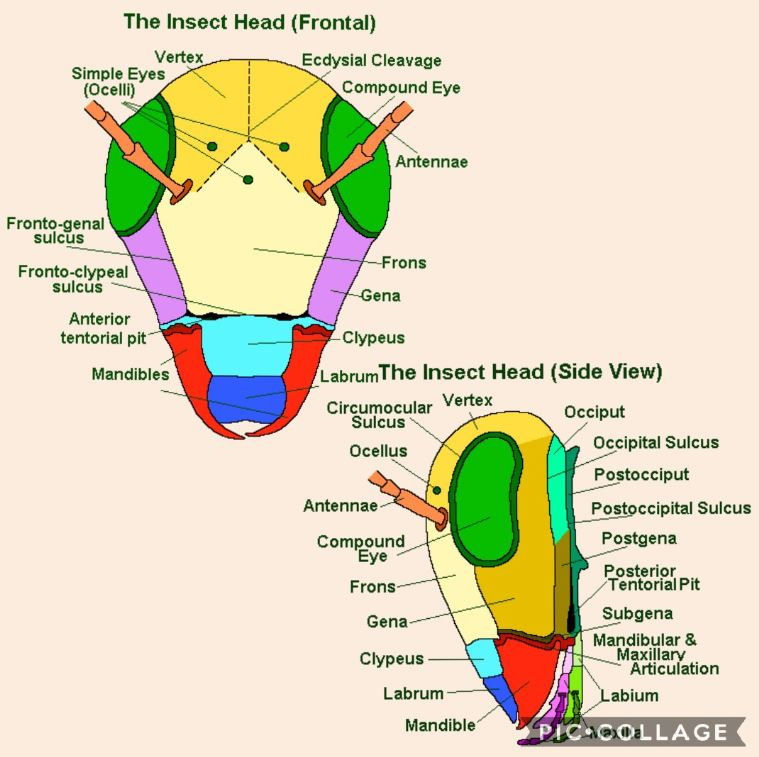
Chewing and grinding insects have mandibles which they use to cut through leaves, wood and other insects. Mandibles can be reinforced with zinc and manganese to make them even harder! They also have marking lines - sulci (sulcus in singular) along which the cuticle (their exoskeleton) is inflected to give increased rigidity. Insects also have suture lines which are lightly fused body parts that can split when the insect is molting. The epicranial suture or ecdysial cleavage (inverted Y shape on the head) is a common suture line in insects. MOUTHPARTS Now let’s take a look at mouthparts, which are very very different from order to order. We can classify mouthparts into 4 main categories. Piercing-sucking mouthparts
They’re used by insects to pierce animal or plant tissues to access the fluids within. These mouthparts are associated with salivary glands that produce secretions to assist with feeding and digest the food. In order to efficiently ingest liquid food, insects with piercing-sucking mouthparts usually have muscular sucking pumps located in their heads. These mouthparts can be found in the Hemiptera.

Here on top, you can see a stink bug (Heteroptera) piercing through a stem. They can sometimes be responsible for plant diseases – phytopathologies. On the bottom, there’s my favorite bug, the giant water bug. I won’t go into too much detail here, but it’s one of the rare non-eusocial species to provide parental care. Studying their behavior would be very interesting! Siphoning mouthparts
These allow insects to siphon liquids such as nectar and water through a long proboscis (sort of trunk that slopes backwards at rest). The proboscis is made up of a modified maxillae and is mostly found in the order Lepidoptera.

White lined sphynx
Sponging mouthparts
These are present in some derived dipteran species such as houseflies. The sponging structure is called labellum, and it is covered in grooves that will collect liquid food through capillary action.
While some Diptera only have sponging mouthparts, others have both cutting and sponging mouthparts. This occurs in blood-feeding flies, such as the horseflies that need to cut through a host skin first before they can access the blood. They do not just feed on horse blood by the way…I’ve experienced it firsthand and I can't help but become paranoid when they’re around me. You don't feel the cut since they anaesthetize the local area surrounding the cut. The pain starts when abiotic conditions, such as sun rays heat the bruise!

Haematopota pluvialis
Chewing lapping mouthparts:
These mouthparts are unique to bees, and we commonly call them bee’s tongue. They allow the bees to feed on liquid nectar. The lapping tongue in social bees is extremely important for pollen feeding, as the small particles they lap up with the nectar are crucial part of their diet. (bees also have mandibles that can be used in nest building, hive defense, and cutting through the basis of flowers to access nectar).

Furthermore, mouthparts can face in 3 different ways:

Hypognathous mouthparts are in a continuous series with the legs and are found in leaf chewing insects for example, such as crickets, katydids, grasshoppers which are all part of the order Orthoptera.
Prognathous mouthparts point forward, which is a sign of a predatory insect. Not all predators have prognathous mouthparts, but usually, almost all prognathous insects are predatory.

Antlion larvae
Opisthorhynchous mouthparts is made of an elongated proboscis that slopes backwards between the forelegs (Lepidoptera).
ANTENNAE
We’ve covered the head extensively, but let’s not forget the antennae. There are several morphologies of antennae. The antennae are best known as olfactory organs that picks up smells, but they can also detect other things, such as tastes, moisture, air currents, vibrations and even heat. Some modified antennae even allow insects to estimate their flight speed. They do this by perceiving air currents and detecting how much the antennae distort at various speeds. Antennae may also be modified to hold onto partners during mating.

Rosalia alpina. A beautiful Cerambycidae
Answer: The silverfish is the insect. Part of the Order Zygentoma. SOURCES - My university lectures - University of Alberta: Bugs 101: Insect-Human Interaction. Can be found on Coursera - 2 Books on entomology which names I don't remember. They're in my uni library, I'll add the titles when this whole covid mess is over and I can go back to uni.
- Lifeyard


Comments